
Pain & Conditions
Shoulder Pain
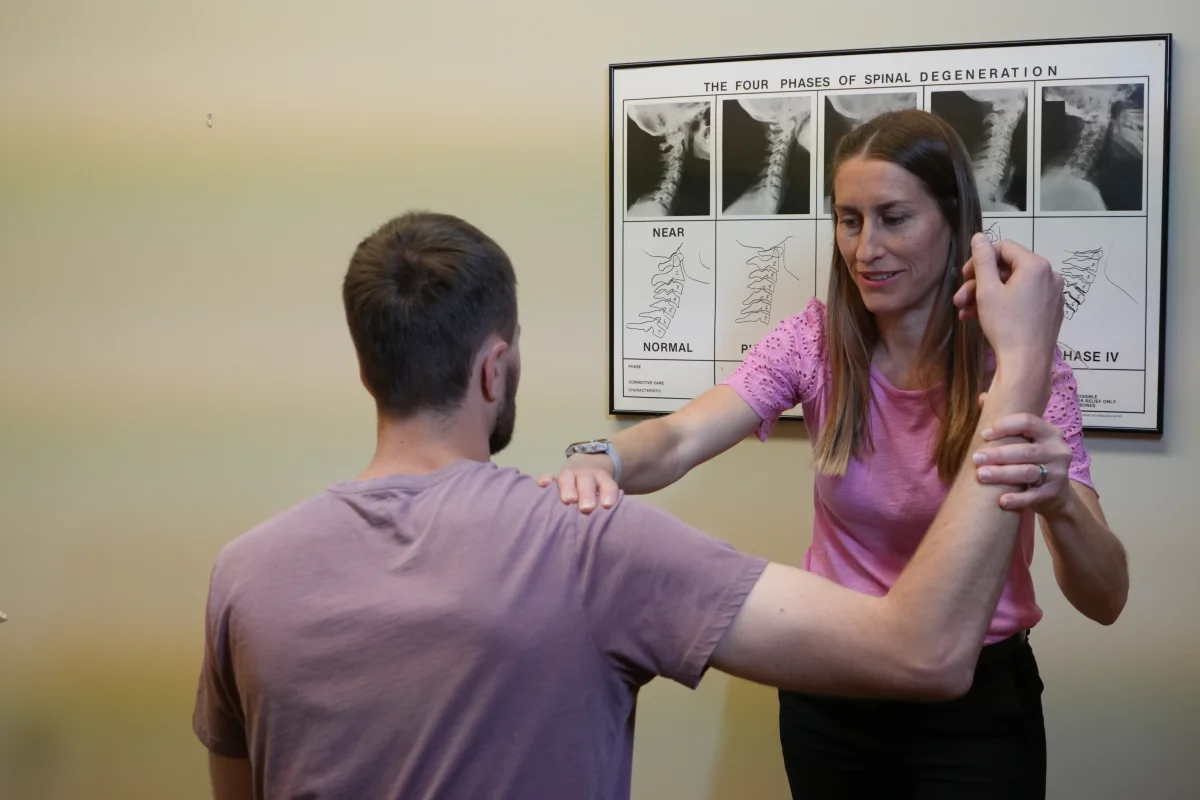
Shoulder pain does not always start in the shoulder. The neck and upper back share so much of the same muscle and nerve supply that a stiff upper back often shows up as a sore shoulder. Whether yours came from a collision, a sport, years of the same repeated motion, or simply time, we look at the whole area rather than only the spot that hurts.
Shoulder pain is deceptive, because the shoulder isn't really one joint. It's a shallow ball and socket held in place mostly by muscle and tendon, riding on a shoulder blade that has to glide across the ribs, connected through the collarbone, and served by nerves that come out of the neck. A problem anywhere along that chain can end up being felt in the same spot on the outside of the arm. That's why two people who describe their pain almost identically, sore reaching overhead and worse lying on that side at night, can have very different things going on. It's also why an exam that tests the shoulder from several angles is more useful than matching your symptoms against a list online.
The usual sources are an irritated rotator cuff, tendons that get pinched under the bony arch as the arm lifts, a frozen shoulder, age-related change in the joint, and pain referred up from the neck and upper back. That last one deserves its own sentence, because it's frequently the missed piece. A stiff neck and a shoulder blade that doesn't move well change how the whole shoulder works, and shoulder pain that keeps coming back after the shoulder itself has been treated is often a neck and upper-back story. Anyone who has taken a fall, played an overhead sport, or spent years at a keyboard has a plausible route into that pattern, which is part of why we ask about all of it.
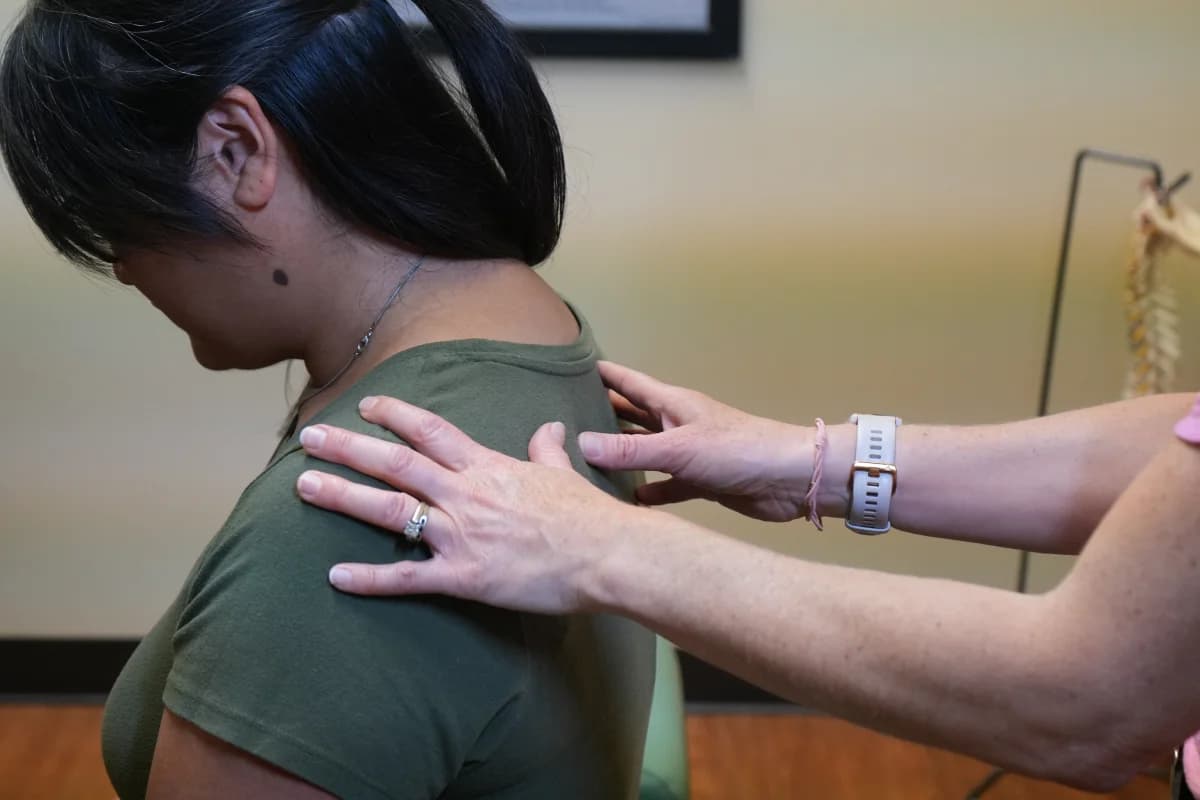
A first visit for a shoulder is a hands-on exam. Dr. Shelly Hogan and Dr. Nicole Edwards check how far the arm moves when you move it and how far it moves when they move it for you, which tell them different things. They test the muscles around the shoulder for strength, watch how the shoulder blade tracks as your arm rises, and look at the neck, because that referral pattern is too common to leave out. You'll get a plain description of what was found and a plain answer about whether this is something we should be working on, which isn't always the same conversation. Bring the details you might assume are irrelevant too: the fall two years ago, the month you spent painting a ceiling, the change in how you sleep. Shoulders tend to carry a history that explains the present better than the current symptoms do.
Where care fits, it usually combines adjustments to the neck and upper back, work on the shoulder joint and shoulder blade themselves, hands-on treatment for muscles and tendons that have been overloaded, and progressive strengthening, because a shoulder that doesn't get stronger tends to keep having the same problem. Frozen shoulder is its own animal and moves on a slow timeline, and we'd rather be honest about that up front than imply it can be hurried. Expect homework as part of it, and expect it to be dull, because most of what holds a shoulder in place is muscle you have to actually train. The office is at 3407 Wells Branch Pkwy, Suite 625, in Wells Branch, North Austin, with parking right at the door, serving North Austin, Wells Branch, and Pflugerville. Book online or call (512) 255-1777.
Common Causes
- Rotator cuff injuries and strains
- Frozen shoulder (adhesive capsulitis)
- A shoulder that pinches or catches when you lift it
- Neck and upper-back tension that shows up in the shoulder
- Bursitis and tendonitis
- Auto accident and sports trauma
Symptoms You May Experience
- Pain when reaching overhead or behind your back
- Aching pain that worsens at night
- Stiffness and limited range of motion
- Weakness when lifting or carrying objects
- Clicking or popping in the shoulder joint
- Pain that radiates from the neck into the shoulder
Treatment Methods
- Spinal and extremity adjustments
- Soft tissue therapy
- Targeted strengthening and stretching exercises
- Electrical stimulation therapy
- Postural correction to reduce strain
Common Questions
Why would a chiropractor look at a shoulder?
Because the shoulder depends on the neck and upper back to work properly. The nerves that supply the arm come from the neck, and the shoulder blade has to move well across the ribs for the joint to function. Chiropractic care works on the joint mechanics, the muscles, and the neck contribution, and sends you elsewhere for the things that need a different kind of doctor.
Could my shoulder pain be coming from my neck?
It genuinely might, and it's one of the more commonly missed explanations. A stiff neck can be felt in the shoulder and upper arm, sometimes with no neck pain at all. Shoulder pain that keeps coming back after the shoulder alone has been treated is a common sign, which is why we look at the neck in every shoulder case.
Do you adjust the shoulder joint itself, and does it hurt?
We work with the whole region, and what that includes comes out of the exam. It often involves the neck and upper back along with mobilizing the shoulder joint and shoulder blade where that's appropriate, plus hands-on work for the muscles and tendons involved. Most people describe it as firm pressure rather than pain. Everything is explained first, and the technique is adapted to what your shoulder tolerates.
What happens at a first visit?
We take your history, then look at the shoulder: how far it moves on its own and how far it moves when we move it, the strength of the muscles around it, how the shoulder blade tracks, and the neck. You get a plain explanation of what was found and what care would involve. Plan on about 45 minutes, and wear something that lets the shoulder be looked at comfortably.
How long does frozen shoulder take?
Longer than anyone wants. Frozen shoulder typically moves through stages over many months, and it isn't something a few visits resolves. Care during that time is generally aimed at keeping the movement you have, working on the neck and upper back so they aren't adding to it, and keeping you as comfortable as possible. Anyone promising you a quick fix isn't being straight with you.
Why does it hurt more at night?
Very common with shoulders. Lying on the sore side compresses the tendons, and sleeping with the arm overhead or tucked under a pillow narrows the space they pass through. Changing sleep position often helps, and we'll go through specific suggestions with you, down to which pillow arrangement tends to work for people with your pattern.
What should I wear?
Something that lets us see and move the shoulder comfortably. A tank top or a loose t-shirt works well, and plenty of people bring one to change into. Bring a photo ID and your insurance card to the first visit, and if you already have notes or images from another provider, bring those along too. It saves time.
How many visits do people usually come for?
It depends on what we find and how long you've had it, and we'd rather tell you after the exam than guess. Straightforward shoulder complaints often take a handful of focused visits plus the exercises at home. Frozen shoulder is a longer road. We check in as we go, and if you aren't changing the way we'd expect, we'll say so and rethink it with you.
Where are you located?
3407 Wells Branch Pkwy, Suite 625, in Wells Branch, North Austin, with parking right at the door. We see people from across North Austin, Wells Branch, and Pflugerville, and the Chicoine family has cared for people in this part of town since 1989. There's one office, this one. No referral is needed in Texas. Book online or call (512) 255-1777. Rosamaria speaks fluent Spanish.
Ready to get started?
Book Appointment (opens in new window)Related Services

Neck Pain
Adjustments and targeted therapy for posture-related, stress-induced, and whiplash neck pain.
Auto Injury
Chiropractic evaluation and care after a car accident, including whiplash, neck pain, and back pain. North Austin office in Wells Branch.
Sports Injury
Natural and effective treatments to help athletes recover faster and get back in the game.
Ready to Start Feeling Better?
Schedule a consultation online or call us and we'll create a treatment plan tailored to your needs.